
The scientific evidence of Qura | Curcumin
Scientific evidence in the supplementation of ulcerative colitis
Curcumin in combination with mesalamine induces remission in patients with Mild-to-Moderate Ulcerative Colitis in a randomized controlled trial. Alon Lang et al. Clin Gastroenterol Hepatol. 2015
Randomized controlled trial of curcumin in combination with mesalamine to induce remission in patients with mild-to-moderate UC.
A group of researchers in Israel designed a randomized clinical trial comparing the efficacy of intestinal-targeted curcumin + mesalamine versus mesalamine alone in patients with mild-to-moderate ulcerative colitis. All patients had previously received mesalamine treatment without response.
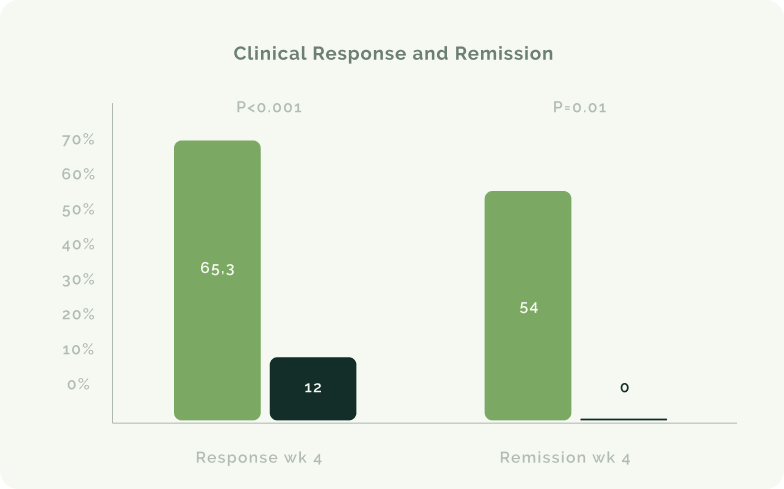
Of the 26 patients who received curcumin+mesalamine, 53.8% achieved clinical remission at 4 weeks, while in the control group no remission was observed.
65.3% (17 pts.) showed clinical responseand endoscopic remission was observed in 38% of the patients in the group that received curcumin+mesalamine.
The study concluded that the administration of intestinal-targeted curcumin along with mesalamine was much more effective than mesalamine alone in achieving clinical and endoscopic remission in patients with active UC who do not respond to first-line pharmacological treatment.
At week 8, 72% of patients showed clinical response, 33% achieved clinical remission, and 61% achieved mucosal healing. Clinical and endoscopic indices, CRP levels, and fecal occult blood test results showed significant improvement. The study concluded that QD is effective in inducing remission in patients with moderate UC. specifically targeted to the intestine in inducing remission in patients with active UC who do not respond to pharmaceutical treatment.
The results were so promising that for the first time, curcumin was included as a complementary treatment in the therapeutic guidelines of the European Crohn’s and Colitis Organization (ECCO) in 2021, which was a major advancement for natural medicine in the field of IBD.
Curcumin maintenance therapy for ulcerative colitis: randomized, multicenter, double-blind, placebo-controlled trial. Hanai H et al. Clin Gastroenterol Hepatol. 2006
Maintenance protocol with curcumin for ulcerative colitis: randomized, multicenter, double-blind, placebo-controlled trial.
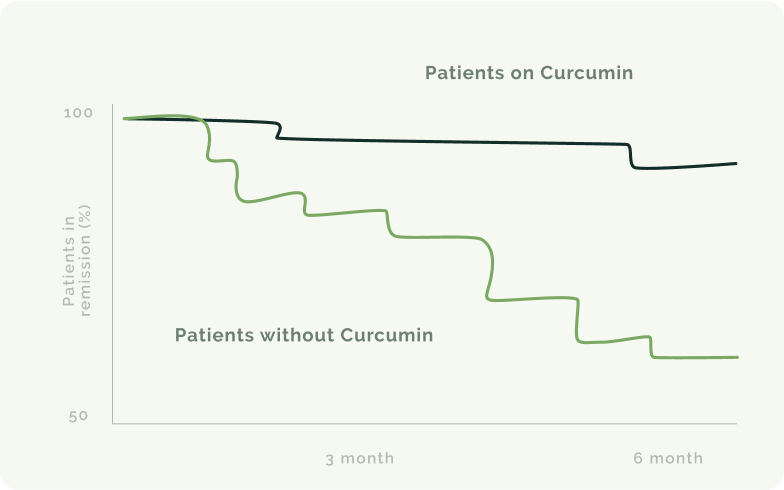
This randomized, multicenter, placebo-controlled clinical trial lasting more than six months more than 6 months, conducted in Japan, evaluated the role of curcumin in maintaining remission.
89 patients (18-64 years) with UC in remission were included, and 45 of them received curcumin with sulfasalazine or mesalamine for 6 months followed by a new observational period of 6 months, with the aim of evaluating the efficacy of curcumin for its maintenance.
The trial analyzed the clinical activity index (CAI) and the endoscopic index (EI) at baseline, every 2 months, at 6 months from the start of supplementation, and subsequently, during the additional 6-month follow-up period.
The clinical trial showed a lower relapse rate and better CAI and EI outcomes in the icurcumin group.
In the following 6 months, higher rate of relapseswas observed after stopping curcumin supplementation.
The study determined that curcumin, as a nutritional supplement, maintains remission for longer than pharmaceutical treatment alone and is therefore a safe and promising supplement for supporting and maintaining remission in patients with UC.
Novel Bioenhanced Curcumin With Mesalamine for Induction of Clinical and Endoscopic Remission in Mild-to-Moderate Ulcerative Colitis: A Randomized Double-Blind Placebo-controlled Pilot Study. Banerjee R, et al. J Clin Gastroenterol. 2021
This study evaluated the efficacy and safety of curcumin as an adjunct to standard treatment to support the induction of remission in mild-to-moderate UC.
Of the 69 patients included in this study, 34 received curcumin along with mesalamine.
Clinical response was also significantly higher in the group that received curcumin.
The 6-month follow-up showed that 95% of patients who responded to curcumin maintained clinical remission.
These results indicate that curcumin as a supplement can help induce prolonged remission in patients with mild-to-moderate UC when administered along with mesalamine.
Efficacy of Indigo Naturalis (QD) Therapy for Ulcerative Colitis: A Case Series. Urushikubo Jun et al. Intern Med. 2019 curcumin in the treatment of Crohn’s disease
Administration of dietary antioxidants for patients with inflammatory bowel disease: A systematic review and meta-analysis of randomized controlled clinical trials. Shahinfar H. et al. Complement Ther Med. 2021
Meta-analysis that studied the effect of curcumin in patients with IBD. They determined that curcumin significantly increased clinical and endoscopic remission in patients with IBD compared to the control group.
In addition, curcumin, when used as a complement to treatment, showed to help achieve significant improvements in clinical response and patient’s quality of life .