To understand how CurQD® works, it is first important to understand what happens at the immunological level inside the gut.
Inflammation is an essential physiological response of the immune system. Under normal conditions, the body releases signalling proteins called cytokines to respond to injury and support tissue repair. Once this function has been fulfilled, the inflammatory response resolves naturally and the immune system returns to a state of balance.
However, under certain circumstances this regulatory mechanism becomes disrupted. Pro-inflammatory cytokines remain active for longer than necessary, perpetuating inflammation and making it harder to repair the intestinal mucosa and maintain its barrier function.
It is precisely at this point that CurQD® plays a differential role.
1.- The Indigo Naturalis (Qing Dai) supports immune balance
CurQD® contains Qing Dai (Indigo naturalis), a botanical ingredient rich in natural bioactive compounds, including indirubin and tryptophan-derived indoles. Several studies have shown that these compounds are able to interact with a receptor known as the aryl hydrocarbon receptor (AhR, Aryl Hydrocarbon Receptor).
AhR receptors are expressed in tissues that remain in continuous contact with the environment, such as the skin, the lungs and, especially, the gut.
In the gut, the AhR pathway plays a fundamental role in regulating the immune response and maintaining intestinal homeostasis.
AhR acts as a true master regulator, determining whether the gut remains under a state of persistent inflammatory stress or recovers the integrity of its mucosal barrier. In other words, it coordinates how the gut responds to environmental stimuli, supporting its functional balance and its capacity to adapt.
For years, effectively activating this receptor directly in the gut has been considered one of the major goals of digestive health research. The “lock” existed, but the “key” that would activate this receptor was missing…
CurQD® acts as that “key”: when the indole compounds present in Qing Dai activate this pathway, they support a shift from a state of excessive inflammation towards an environment characterised by immune regulation and tissue repair.
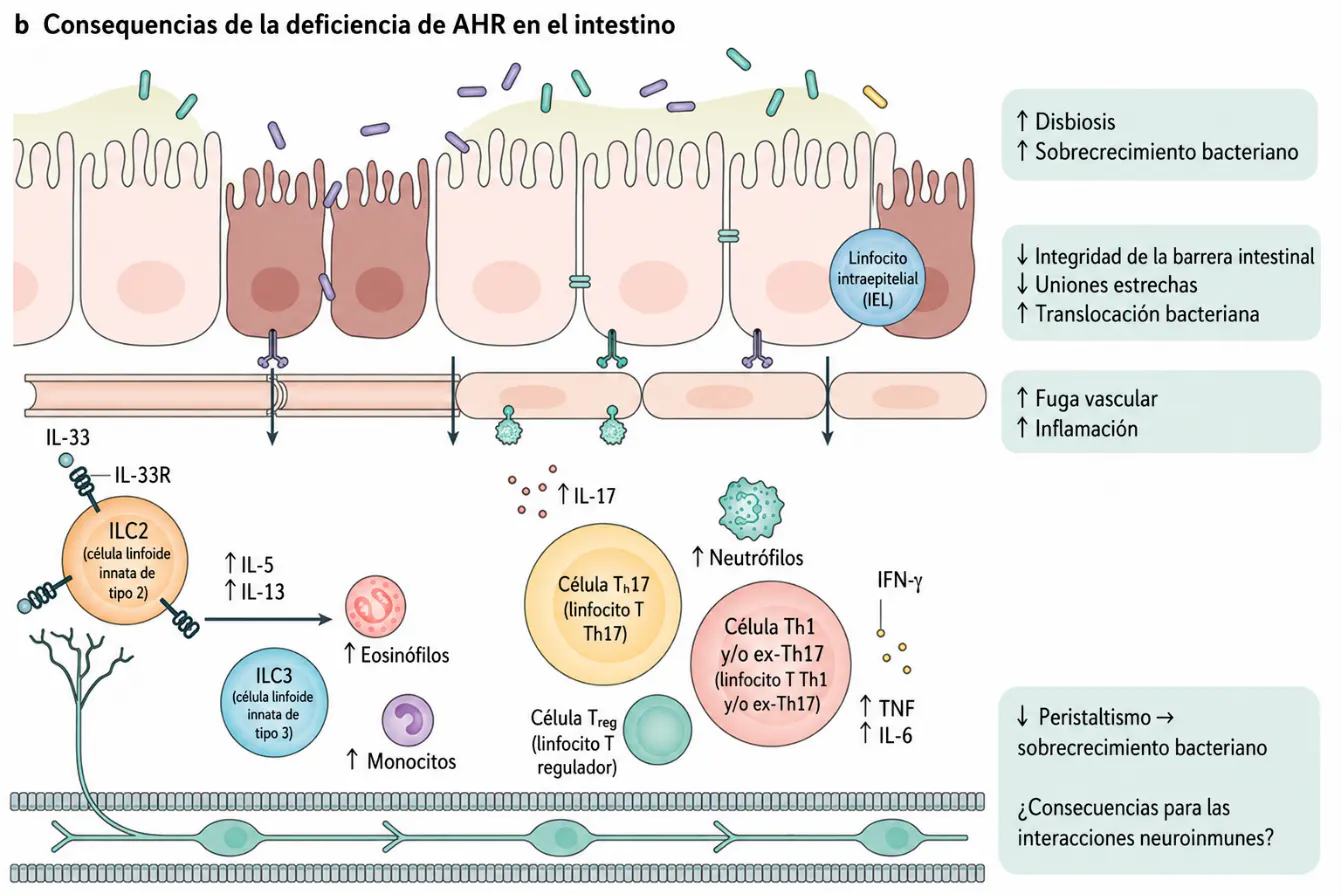
Image extracted and translated from: Stockinger B, Shah K, Wincent E. AHR in the intestinal microenvironment: safeguarding barrier function. Nat Rev Gastroenterol Hepatol. 2021 Aug;18(8):559-570. doi: 10.1038/s41575-021-00430-8.
2.- Benefits of activating the AhR pathway
The activation of the AhR receptor triggers several beneficial biological effects, including:
Increased production of interleukin-22 (IL-22), a cytokine essential for tissue repair and maintaining the integrity of the intestinal barrier.
Decreased expression of pro-inflammatory cytokines such as IL-6, IL-1 and TNF-α.
Inhibition of the NF-κB signalling pathway, one of the main mechanisms responsible for maintaining chronic inflammation.
Support for an intestinal immune environment that is more balanced and less inflammatory.
Rather than producing generalised immunosuppression, this pathway helps to restore the physiological balance of the immune system, allowing the natural repair and regeneration mechanisms to act more effectively.
3.- A dual mechanism of action: what happens when the “switch” is activated?
Thanks to the precise molecular combination of curcumin specifically formulated to target the gut and Qing Dai, CurQD® activates the AhR receptor and simultaneously sets in motion two fundamental biological processes in the gut.
1. Structural reinforcement of the intestinal barrier
CurQD® supports the strengthening of the physical architecture of the intestinal mucosa. This process includes support for the tight junctions between epithelial cells and the maintenance of the protective mucous layer that lines the gut. The result is: a more intact and resilient intestinal barrier, able to prevent the passage of potentially harmful molecules, bacteria and microorganisms, acting as an effective first line of defence.
2. Regulation of the immune microenvironment
Beyond structural reinforcement, CurQD® helps to optimise the biological environment of the gut. It modulates local molecular signalling, reducing excessive inflammatory activity and lowering persistent immune stress. The result is: the gut progressively moves from a state of continuous defence and inflammation to a situation of homeostasis, stability and immune balance.
4.- Enhancing the body’s natural regulatory mechanisms
Because of its central role in immune regulation, the AhR pathway has become one of the main focuses of gut health research.
The Qing Dai in CurQD®, at the doses in which it is formulated, is one of the few natural compounds capable of significantly activating this biological pathway, enhancing the body’s own regulatory mechanisms, helping to modulate the excessive immune response, contributing to the long-term maintenance of intestinal balance, and supporting the physiological processes of stabilisation and repair of the intestinal mucosa.
5.- How CurQD® can enhance a comprehensive strategy for gut care?
CurQD® represents an innovative protocol, designed not only to be used on its own, but also as a supplement capable of providing the nutritional support needed to optimise gut health. One of its most distinctive features is its ability to act as a molecular optimiser for any gut health management strategy. Rather than simply accompanying existing therapeutic or nutritional measures, CurQD® strengthens the biological mechanisms on which these act.
Rather than simply adding a new component to the gut care routine, CurQD® acts as a tool designed to reinforce the fundamental mechanisms that underpin intestinal homeostasis, supporting the transition from a state of persistent inflammation to a situation of sustained functional stability.
When the intestinal barrier maintains adequate structural integrity and the immune environment is balanced, any strategy aimed at gut care can develop under more favourable conditions and achieve greater effectiveness.
CurQD® helps reduce excessive immune activation, supports the integrity of the intestinal mucosa and provides a more solid biological foundation for maintaining intestinal balance and promoting sustained long-term results.
References
Ben-Horin S, Salomon N, Karampekos G, et al. Curcumin-QingDai Combination for Patients With Active Ulcerative Colitis: A Randomized, Double-Blinded, Placebo-Controlled Trial. Clin Gastroenterol Hepatol. 2024;22(2):347-356.e6. doi:10.1016/j.cgh.2023.05.023
N Krugliak Cleveland, C Duty, K Bhondwe, D T Rubin, P0734 Real-World Experience of Curcumin+Qing Dai Reduces Biochemical and Intestinal Ultrasound Disease Markers in Patients with Inflammatory Bowel Disease, Journal of Crohn’s and Colitis, Volume 19, Issue Supplement_1, January 2025, Pages i1424–i1426, https://doi.org/10.1093/ecco-jcc/jjae190.0908
Salomon N, Marom M, Odeh S, Molnar M, Shitrit AB, Nayshool O, Ungar B, Ben-Horin S, Rainis T. Curcumin-QingDai combination for patients with active Crohn’s disease: a retrospective, real-world multicenter cohort study. Front Gastroenterol (Lausanne). 2025 Jul 15;4:1602541. doi: 10.3389/fgstr.2025.1602541.
Mallory Chavannes, Prashanthi Kandavel, Tanaz Danialifar, Jonathan Dillman, D Brent Polk, Clinical, biochemical, and intestinal ultrasonography response to curcumin-qingdai (curqd) combination in pediatric patients with inflammatory bowel disease: a case series, Inflammatory Bowel Diseases, Volume 30, Issue Supplement_1, February 2024, Pages S18–S19, https://doi.org/10.1093/ibd/izae020.044
We have updated the CurQD® portfolio to offer a more flexible and personalised use, adapted to each patient’s real needs.
CurQD®-1:is no longer available. Instead, you should purchase CurQD®-3
CurQD®-3: induction in moderate-to-severe intestinal dysfunction
CurQD®-5: induction in mild intestinal dysfunction, step-down after CurQD®-3 and maintenance in patients with an insufficient response to Qura or early relapse NEW!!!
Dispones de 14 días naturales desde la recepción del producto/s para desistir o devolver el mismo.
No se admite la devolución ni el desistimiento, por razones de protección de la salud e higiene, cuando el envoltorio, embalaje o precinto que protege el producto, haya sido abierto. El producto deberá estar envuelto adecuadamente, con la etiqueta original, no manipulado y con todos sus componentes originales.
Puedes iniciar la devolución del producto contactándonos:
Enviaremos un mensajero a recoger el producto en la dirección que nos facilites. Entrega el producto al transportista.
El reembolso se realizará por el mismo medio de pago con el que se abonó el producto y por el importe correspondiente. Se realizará antes de que hayan transcurrido 14 días desde la fecha de recepción de la devolución en las oficinas de Adacyte.
Los gastos derivados de la recogida del producto correrán a cargo de Adacyte.
Para cualquier duda, sugerencia, consulta o reclamación sobre la tienda online, puedes dirigirte al Servicio de atención al cliente.
Atención al cliente:
Teléfono 93 400 67 01 (en horario de lunes a jueves de 09:00h a 18:00h y viernes de 09:00h a 15:00h)
Disponemos de hojas de reclamaciones oficiales a disposición de los consumidores y usuarios, que podrán ser presentadas en la dirección postal y correo electrónico arriba indicados.
Puedes solicitar la hoja de reclamaciones llamando al teléfono de atención al cliente o descargarla directamente aquí: Descargar hojas oficiales.
El Servicio de atención al cliente de Adacyte atenderá y dará respuesta a tu reclamación a la mayor brevedad posible, y siempre en el plazo máximo de un mes.
Las cookies son importantes para ti, influyen en tu experiencia de navegación, nos ayudan a proteger tu privacidad y permiten realizar las peticiones que nos solicites a través de la web. Utilizamos cookies propias y de terceros para analizar nuestros servicios y mostrarte publicidad relacionada con tus preferencias en base a un perfil elaborado con tus hábitos de navegación.
Puedes Aceptar o Rechazar aquellas cookies que no sean técnicas, así o también configurar tus preferencias pulsando Configurar Cookies.
Más información, consulta nuestra Política de Cookies
Configurar